China has become a major manufacturing base for passive optical network components. Its Fiber Cable Splitter suppliers serve FTTH deployments, data centers, and regional broadband projects. However, “top” should not mean the largest factory alone. Performance, traceability, testing, and after-sales support matter equally.
Charles K. Kao, widely recognized as the father of fiber-optic communications, said, “We need to find a way of making glass transparent.” His insight still shapes today’s splitter market. A reliable supplier must control light distribution through precise PLC or FBT technology. It should also provide stable insertion loss, low polarization sensitivity, and consistent port uniformity. Small details matter. Connector end-face quality can affect a cabinet’s real-world performance.
This overview examines leading Chinese suppliers, including established network-equipment manufacturers and specialized optical-component companies. It considers product range, factory capability, certification, customization, and delivery experience. Typical evaluation points include 1x8, 1x16, and 1x32 configurations, SC or LC connectors, operating temperature, and packaging for outdoor enclosures. Compliance with standards such as Telcordia GR-1209 and GR-1221 can strengthen buyer confidence. Still, certification claims require verification.
Supplier rankings are rarely permanent. Public information may be incomplete, and product quality can vary between batches. A polished website proves little. Buyers should request test reports, sample units, loss data, and production references before making a decision. This article therefore treats “top” as a practical assessment, not an absolute label. The strongest Fiber Cable Splitter supplier is the one that performs reliably in the buyer’s actual network conditions.
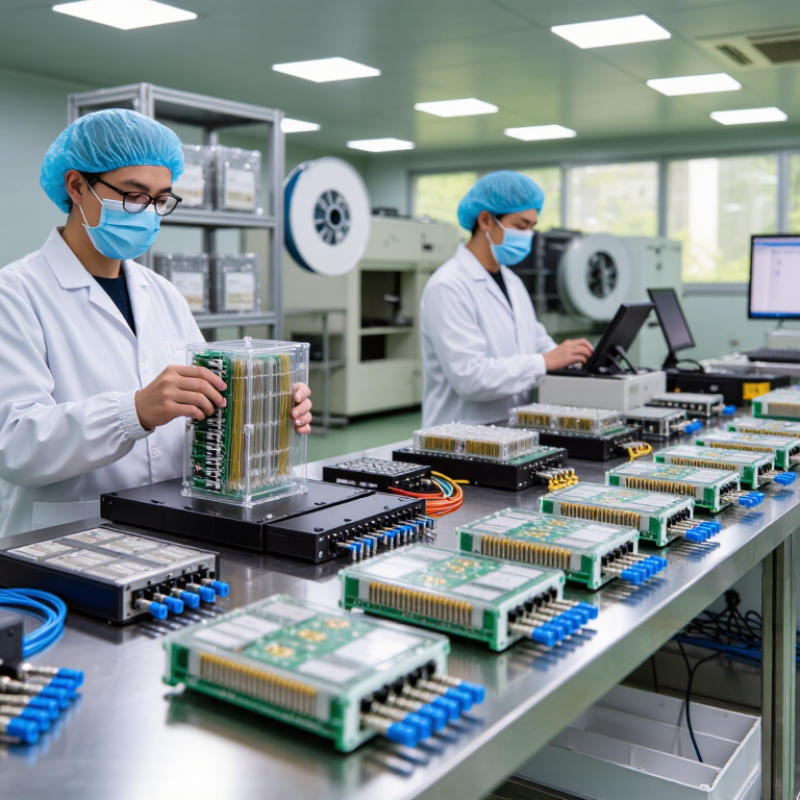
A fiber cable splitter divides one optical signal into several paths. It uses no electronic power in passive networks. Instead, internal optical elements distribute light among connected fibers. Common designs include PLC splitters and FBT splitters. PLC models usually provide more even performance across multiple wavelengths.
The working process is straightforward but not careless. Light enters through an input fiber. The splitter divides its optical power among two, four, eight, or more outputs. Each additional output reduces the available signal strength. This reduction is called insertion loss. Excessive loss can weaken service at the receiving equipment. Clean connectors and correct bend radius matter greatly.
In real installations, technicians check port labels, fiber polarity, and connector faces before testing. A small dust particle can create noticeable attenuation. Suppliers should provide measured loss data, temperature ratings, and reliable inspection records. Housing quality also matters in cabinets exposed to vibration or humidity. The first design choice is not always the best one. Engineers may need to reconsider the split ratio after measuring actual link distance. Supplier claims deserve verification through sample testing and optical power measurements. A splitter can appear simple, yet poor installation discipline can undermine an otherwise qualified component.
China has become a major fiber cable splitter supplier because demand, manufacturing, and testing capabilities developed together. The Ministry of Industry and Information Technology reported more than one billion FTTH/O ports in China by the end of 2023. That installed base creates strong demand for PLC splitters, FBT splitters, cabinets, and connectorized assemblies. It also gives local manufacturers practical experience with dense urban networks and difficult rural installations.
Global demand supports this scale. The ITU Facts and Figures 2023 report recorded about 1.4 billion fixed-broadband subscriptions worldwide. China’s large domestic market helps suppliers purchase splitters, fiber, housings, and ceramic components in volume. Shorter supply chains can reduce lead times and support customized split ratios. However, low pricing alone proves little. Quality may vary between production batches. Some advertised capacity also needs independent verification.
Tips: Ask for insertion-loss and return-loss records. Confirm operating temperature, connector type, split ratio, and compliance with IEC 61753. Request sample testing before placing a large order. A supplier should explain its process clearly, not only provide a catalog. Field experience matters. Mistakes still happen. Even experienced buyers should compare test results, packaging quality, and after-sales response before choosing a long-term manufacturing partner.
China’s fiber cable splitter suppliers commonly produce several architectures for different network conditions. PLC splitters use planar waveguide technology and support stable 1xN or 2xN distribution. They suit broadband access networks where uniform splitting matters. FBT splitters combine fibers through controlled heating and stretching. They can work well in smaller ratios, such as 1x2 or 1x4.
An overlooked choice is the package. Bare-fiber splitters fit compact closures and leave little installation space. ABS-module splitters offer stronger protection for indoor boxes. Rack-mounted versions simplify maintenance in dense equipment rooms. Connectorized splitters reduce field splicing, but their adapters increase size and cleaning requirements. During site inspections, technicians often compare connector type, cable length, bend radius, and port labeling before ordering.
Reliable suppliers should provide insertion-loss, return-loss, and polarization-dependent-loss data. They should also document testing across operating wavelengths, temperature cycles, and mechanical stress. A datasheet can look perfect, but real cabinet conditions may expose weak packaging. Field temperature changes can matter. Some projects need equal splitting across 1260–1650 nanometers. Others prioritize low loss on a specific access wavelength. That distinction deserves careful review. Suppliers with traceable inspection records, clear samples, and responsive technical support usually offer more dependable purchasing decisions. Mistakes still happen, especially when engineers treat every splitter type as interchangeable.
| Splitter Type | Typical Split Ratios | Typical Insertion Loss | Operating Wavelength | Typical Optical Performance | Common Packaging | Typical Applications | Key Selection Criteria |
|---|---|---|---|---|---|---|---|
| PLC Splitter Planar Lightwave Circuit |
1×2, 1×4, 1×8, 1×16, 1×32, 1×64; 2×N versions also available | Approximately 4.0 dB for 1×2 to 20.5 dB for 1×64, excluding connector loss | 1260–1650 nm; commonly specified at 1310, 1490 and 1550 nm | Low excess loss, good uniformity, broadband operation and stable temperature performance | Bare fiber, mini-tube, steel tube, blockless, ABS module, LGX module and rack-mount chassis | FTTH, PON networks, central offices, fiber distribution boxes and data-center cabling | Split ratio, maximum insertion loss, uniformity, return loss, operating temperature and housing size |
| FBT Splitter Fused Biconical Taper |
1×2 and 2×2 are common; custom asymmetric ratios are available | Typically about 3.5–4.2 dB for a balanced 1×2 splitter; depends strongly on the split ratio | Usually optimized for one or two telecom windows, such as 1310/1550 nm | Flexible coupling ratios and economical for low split counts; wavelength sensitivity is higher than PLC | Steel tube, ABS box, cassette and custom multi-window modules | Local optical monitoring, low-count PON branches, wavelength-specific networks and legacy systems | Required wavelength range, coupling ratio, thermal stability, environmental sealing and cost |
| Uniform PLC Splitter Balanced Power Distribution |
1×4, 1×8, 1×16, 1×32 and 1×64 | Approximately 7.4 dB for 1×4, 10.5 dB for 1×8, 13.8 dB for 1×16 and 17.1 dB for 1×32 | 1260–1650 nm | Typically low output uniformity variation, often within about 0.8–1.0 dB depending on split count and specification | Cassette, ABS box, rack module, tray module and sealed outdoor enclosure | Balanced optical distribution in GPON, XG-PON, XGS-PON and other passive optical networks | Optical budget, connector configuration, fiber type, port labeling and installation density |
| Asymmetric PLC Splitter Unequal Power Distribution |
Common examples include 10/90, 20/80, 30/70 and 40/60 | Varies with the coupling ratio; the lower-power output has higher attenuation | 1260–1650 nm | Designed to provide controlled power imbalance while maintaining broadband transmission | Bare fiber, steel tube, blockless, ABS box and custom module | Optical network monitoring, signal tapping, test access and staged distribution architectures | Exact coupling ratio, tap-port loss, wavelength flatness, return loss and connector type |
| Outdoor FTTH Splitter Environmentally Protected Assembly |
1×4, 1×8, 1×16 and 1×32 are widely used | Based on the internal PLC or FBT element; typical 1×8 PLC loss is around 10.5 dB maximum excluding connectors | 1260–1650 nm | Performance depends on sealing, fiber routing, bend control and internal splitter quality | IP-rated closure, dome closure, outdoor distribution box, splice tray and drop-cable terminal | Aerial, duct, pole-mounted, underground and building-entry FTTH deployments | Ingress protection, cable entry method, sealing material, splice capacity, temperature range and impact resistance |
| Rack-Mount Splitter High-Density Centralized Module |
1×8, 1×16, 1×32 and 1×64; multi-input configurations available | Determined by the installed splitter ratio; a 1×32 PLC unit is commonly specified around 17.1 dB maximum excluding connectors | 1260–1650 nm | Consistent performance with improved fiber management and front-access port identification | 19-inch rack chassis, 1U/2U panels, sliding trays and modular cassettes | Telecom rooms, central offices, data centers and high-density ODN distribution points | Rack height, port density, bend-radius management, labeling, cable routing and maintenance access |
| Connectorized Splitter Factory-Terminated Assembly |
Available with most PLC or FBT ratios, including 1×2 through 1×64 | Splitter loss plus connector loss; each mated connection commonly adds approximately 0.2–0.5 dB | 1260–1650 nm, subject to the internal splitter specification | Fast deployment and reduced field splicing, provided connectors are clean and correctly matched | SC, LC or other specified connector interfaces; fan-out, cassette, box and module formats | FTTH cabinets, distribution boxes, test systems and pre-terminated optical networks | Connector polish, insertion loss, return loss, connector compatibility, cable length and dust protection |
Identifying reliable fiber cable splitter suppliers requires more than comparing prices. Check whether the supplier operates its own production facility or uses unverified subcontractors. A clear factory address, stable engineering team, and documented quality process provide useful evidence. Ask for recent test reports covering insertion loss, return loss, uniformity, and wavelength performance. These figures should match recognized industry standards, not vague marketing claims.
Request samples before placing a large order. Examine connector polishing, cable protection, labels, packaging, and dimensional consistency. For PLC splitters, test several samples from different batches. A supplier that shares raw material details and production records usually understands traceability. Confirm compliance with applicable IEC, Telcordia, RoHS, and local export requirements. Standards alone are not enough.
Communication also reveals technical maturity. Strong suppliers explain tolerances, operating temperature, fiber type, and installation conditions clearly. They should provide drawings, inspection records, and a realistic production schedule. Ask how they handle defective units and engineering changes. Cheap quotations can hide weak testing or unstable components.
I once focused too heavily on unit cost; the later rework cost more than expected. That experience remains a useful warning. A capable supplier may not promise everything immediately. Sometimes, careful questions are better evidence than fast answers.
When evaluating China’s fiber cable splitter suppliers, buyers should examine more than unit price. A dependable supplier can explain split ratios, insertion loss, return loss, connector types, and operating temperature. Ask for recent test reports linked to specific production batches. Ask for evidence.
Technical documents should match the actual product. Check whether the stated performance covers the required wavelength, such as 1310, 1490, or 1550 nanometers. Confirm the splitter’s package size, bend radius, fiber type, and connector polish. Numbers need context. A low insertion-loss figure may depend on testing conditions that differ from your network. Request samples and test them with your own equipment before placing a large order. Test before scaling.
Production consistency also deserves close attention. Review incoming material controls, fiber alignment methods, inspection records, and batch traceability. Reliable suppliers normally provide clear quality procedures and respond with specific corrective actions when defects appear. Verify relevant certifications independently, rather than trusting a logo on a quotation. Lead time, minimum order quantity, packaging strength, and replacement policies also affect the real purchasing cost. A factory may offer excellent samples but struggle with volume delivery; this is an easy risk to overlook. Ask for shipment records, reference projects, and a realistic production schedule. Face-to-face audits or live factory inspections can reveal details that polished brochures often hide.
A fiber cable splitter divides one optical signal into several fiber paths. It works passively, without electronic power. Light enters through one input fiber and leaves through multiple outputs.
Each additional output receives less optical power. This reduction is called insertion loss. A 1x8 splitter usually creates more loss than a 1x2 model. Excessive loss can weaken the receiving equipment’s signal.
PLC splitters use planar waveguide technology and support stable 1xN or 2xN distribution. FBT splitters combine fibers through controlled heating and stretching. PLC designs often provide more even performance across several wavelengths.
Bare-fiber models fit compact closures with limited space. ABS-module versions provide stronger protection inside indoor boxes. Rack-mounted units support easier maintenance in dense equipment rooms. Connectorized models reduce field splicing but need more cleaning.
Check port labels, fiber polarity, connector faces, and bend radius. Keep connectors clean. A tiny dust particle can cause noticeable attenuation. Small details matter. Poor handling can damage a good component’s performance.
Request insertion-loss, return-loss, and polarization-dependent-loss data. Confirm testing across required wavelengths and temperatures. Ask for package dimensions, fiber type, connector polish, and cable length. Numbers need context.
Request samples linked to recent production batches. Test them with your own optical equipment before scaling orders. Review inspection records, batch traceability, and corrective actions. A polished datasheet is not proof.
Low unit price may hide weak packaging, long lead times, or inconsistent volume production. Check minimum order quantities, replacement policies, and shipment records. Factory inspections can reveal practical problems. The first choice may need reconsideration.
A Fiber Cable Splitter is a passive optical device that divides one incoming fiber signal into multiple output paths, allowing a single network connection to serve several users or terminals. It is widely used in fiber-to-the-home, telecommunications, data centers, and other optical communication systems. China has become a major supplier because of its mature manufacturing infrastructure, broad production capacity, competitive pricing, and ability to provide customized solutions. Chinese manufacturers produce various types, including PLC splitters, FBT splitters, rack-mounted models, cassette designs, and outdoor or indoor configurations.
To identify top Fiber Cable Splitter suppliers, buyers should evaluate product quality, optical performance, manufacturing experience, testing procedures, certifications, delivery capability, and after-sales support. Before selecting a supplier, it is also important to compare insertion loss, uniformity, operating wavelength, durability, connector options, packaging, customization services, and total cost. A reliable supplier should offer consistent performance, clear technical documentation, stable communication, and dependable long-term cooperation.

KOCENT OPTEC