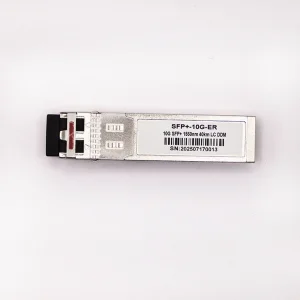
The telecommunications industry's transition from 10G/40G architectures to high-density 100G infrastructure has designated the QSFP28 100G LR4 (Long Range 4) optical transceiver as the standard benchmark for single-mode fiber (SMF) links up to 10 kilometers. Built to satisfy the demanding physical layer specifications of IEEE 802.3ba and the QSFP28 MSA (Multi-Source Agreement), this module implements an efficient WDM layout to maximize transmission bandwidth.
Unlike short-reach modules utilizing parallel multimode fibers, the 100G LR4 architecture interfaces over a duplex LC connector using four distinct Lan-WDM (Local Area Network Wavelength Division Multiplexing) wavelengths. These channels operate within the O-band region to minimize material dispersion, specifically centered at:
By leveraging an array of four discrete DFB (Distributed Feedback) or EML (Electro-absorption Modulated) lasers running at 25.78 Gbps (per CEI-28G-VSR host electrical lanes), the 100G LR4 module aggregates these signals using an internal optical multiplexer (MUX) onto a single single-mode fiber core. At the receiving end, an optical demultiplexer (DEMUX) separates the wavelengths back to high-sensitivity PIN or APD photodiode receivers, achieving error-free performance with a typical total power budget of 6.3 dB to 8.5 dB depending on standard classifications.
Sourcing cost-effective (cheap) 100G LR4 products without compromising performance requires a deep understanding of China's optical manufacturing clusters. Leading hubs, such as Wuhan (China's Optics Valley) and Shenzhen, maintain an unmatched structural advantage in producing precision passive and active network components.
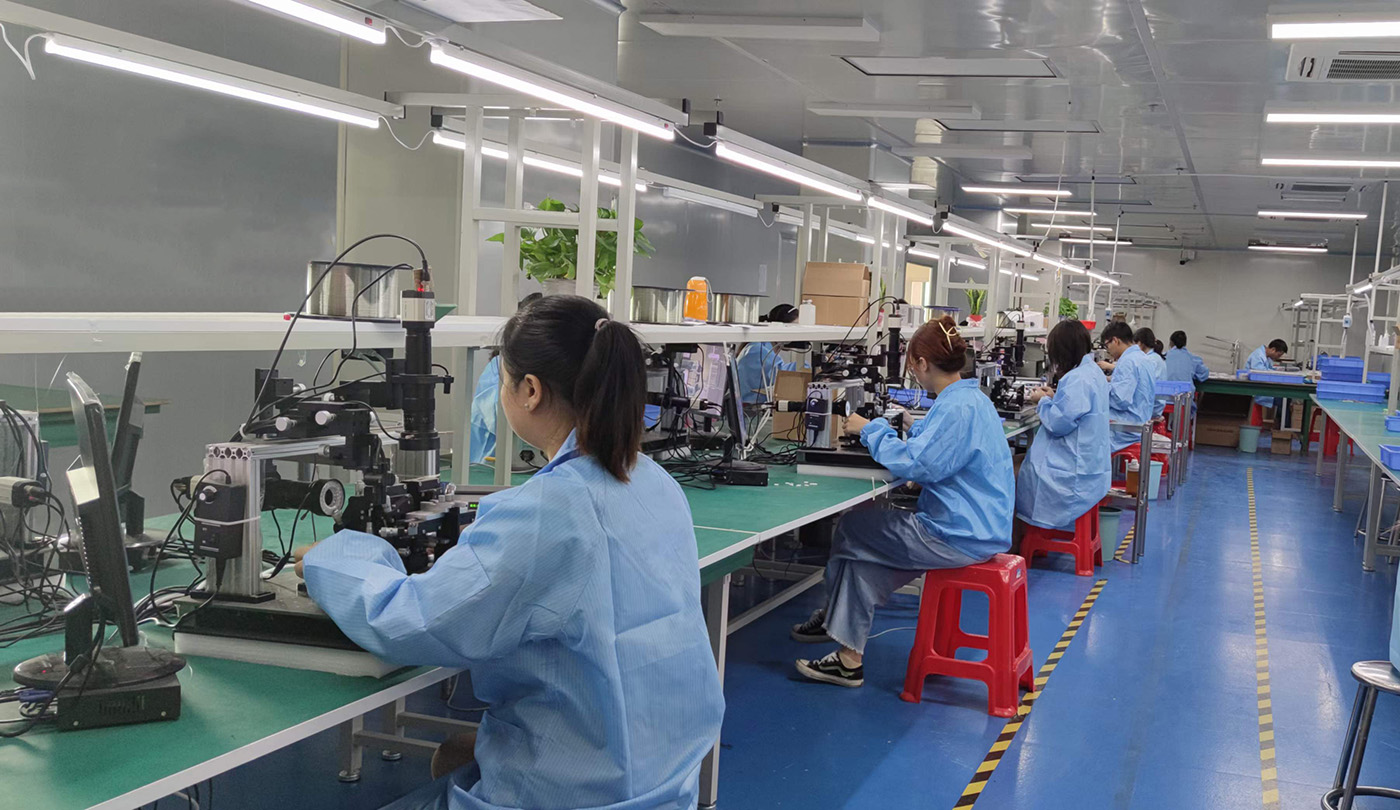
Optical alignment represents the most capital-intensive phase of LR4 manufacturing. Chinese factories utilize automated sub-micron active alignment systems to position laser diodes, lenses, and optical fibers with spatial precision below 0.1 µm. This minimizes transmitter optical path loss and boosts yields.
ISO Class 5 and Class 6 cleanrooms protect wafer-level dicing, die bonding, and wire bonding processes. By maintaining controlled temperature, humidity, and particle levels, manufacturers eliminate contamination hazards that cause micro-reflections and premature laser degradation.
Before shipment, 100% of transceiver modules undergo stress testing in high-temperature aging chambers and traffic validation systems. Real-time eye diagram analysis, bit error rate (BER) checks, and hardware compatibility validation assure reliability.
In high-speed optical hardware, "cheap" does not mean low-quality; it refers to the optimization of production scales. By standardizing component manufacturing and securing raw optical materials through integrated supply chains, manufacturers reduce overhead. This enables global operators and data center builders to purchase high-reliability 100G LR4 transceivers at competitive price points.
Procurement teams sourcing 100G LR4 modules must evaluate technical parameters against industrial standards. The matrix below outlines the critical parameters required to ensure interoperability and operational stability across heterogeneous environments:
| Parameter Block | Specification Value | Industry Standard / Compliance |
|---|---|---|
| Form Factor | QSFP28 (Quad Small Form-factor Pluggable 28) | SFF-8665, SFF-8636 Compliant |
| Data Rate per Lane | 25.78125 Gbps (4 Lanes total 103.125 Gbps) | IEEE 802.3ba 100GBASE-LR4 |
| Optics Type | DFB or EML Cooled Transmitters & PIN / APD Receivers | LAN-WDM Grid (1295.56 - 1309.14 nm) |
| Fiber Type & Distance | Single-mode Fiber (G.652 SMF) - up to 10 km | IEEE 802.3ba standard distance limits |
| Diagnostics & Monitoring | DDM / DOM (Digital Diagnostics Monitoring) | SFF-8636, monitoring voltage, temperature, bias current |
| Laser Safety Class | Class 1 Eye Safety | FDA / IEC 60825-1 Compliant |
Modern telecommunication networks deploy 100G LR4 optical modules across a range of network tiers, linking long-range backbones with local aggregation nodes.
Hyperscale cloud facilities and multi-tenant data centers deploy 100G LR4 to bridge separated availability zones located up to 10 kilometers apart. This setup enables synchronous replication, low-latency disaster recovery, and resource pool sharing without requiring optical amplification.
Multi-building university campuses, research centers, and global financial hubs use 100G LR4 links to create private fiber networks. These links connect edge switches to central core routing platforms, guaranteeing bandwidth for high-performance computing (HPC) tasks.
As 5G base stations handle growing data volumes, mobile operators use 100G LR4 to aggregate baseband units (BBUs) and distributed units (DUs) over metropolitan networks. This helps maintain low latency and high reliability across wide service areas.
Local exchange centers and point-of-presence (PoP) hubs use 100G LR4 to construct transport networks. The 10km range over standard single-mode fiber handles localized routing runs without incurring dispersion penalties or requiring dispersion compensation modules.
Kocent Optec Limited established in 2012 in Hongkong as a hi-tech communication enterprise, is one of China's leading fiber optic termination product manufacturer and solution provider.
We're dedicated to developing and manufacturing fiber optic communication products ranging from passive to active categories for telecommunication networks, enterprise networks and data centers.
By leveraging our extensive experience and excellent production capacity we gained over the years, we magnify the outcome for our valuable customers, which ultimately expands their core competencies and helps them outperform competitors. We place emphasis on customer collaboration, and we define ourselves as your valuable partner in fiber optic connection solutions. We believe our differentiators are your perceived advantages.
With more than 13 years of experience in manufacturing telecommunication fiber optic products, we follow strictly fiber optic industry standards by using mature scientific methods to deliver your products on time and ensure that 100% products are tested and inspected before shipment.

Years of sales and service experience have enabled us to win customers from different regions. Today, we have customers from East Asia, Southeast Asia, Middle East, Eastern Europe, Western Europe, Northern Europe, South America, North America, North Africa, and South Africa.
Win-win cooperation is our constant goal. Many our OEM and ODM products won the Telecom Operator tender and satisfy end-user request.
Our main terminal telecom operators include:
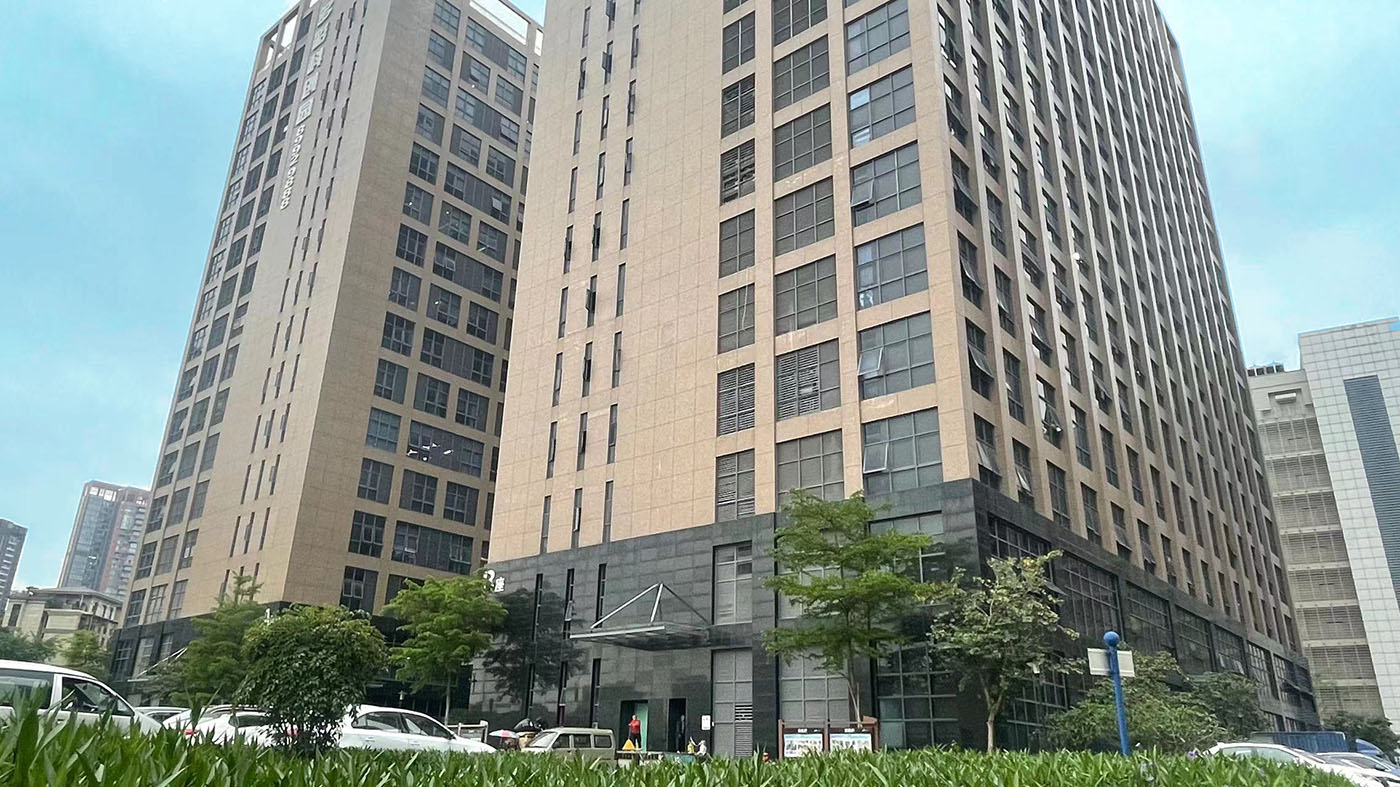
Our commitment to telecom-grade performance requires continuous process updates. We source premium components, verify fiber geometry, and check connector endfaces for scratches, pits, or contamination. Operating under cleanroom environments with automated testing systems, Kocent Optec ensures every fiber patch cord, adapter, transceiver, and optical chassis meets Telcordia GR-326-CORE specifications, delivering low insertion loss and high return loss.
Find answers to technical and supply chain questions regarding 100G LR4 transceiver deployment and sourcing.
The main differences are transmission distance, wavelength spacing, and optical components. 100G LR4 is designed for up to 10 km over duplex Single-Mode Fiber (SMF) using LAN-WDM wavelengths (800 GHz spacing in the O-band) with cooled DFB/EML lasers. 100G CWDM4 is designed for shorter distances, typically up to 2 km, using CWDM wavelengths (20 nm spacing) with uncooled lasers. CWDM4 relies on Host FEC, whereas standard 100G LR4 can achieve error-free performance without Host FEC on shorter spans, though it is recommended for 10km reaches.
Price variations stem from laser diode sourcing (EML vs. DFB), manufacturing automation, and testing protocol depth. "Cheap" modules from tier-1 Chinese manufacturers utilize automated active optical alignment systems and scale efficiencies. Sourcing directly from high-volume manufacturers reduces markups while maintaining compatibility, testing, and optical performance.
Yes. While major switch vendors utilize firmware serialization checks to lock devices, manufacturers can code EEPROM microcontrollers to match specific vendors (Cisco, Juniper, Arista, Huawei, etc.). Specifying target equipment configurations during procurement ensures seamless integration and DOM functionality.
According to IEEE 802.3ba standards, 100GBASE-LR4 links can achieve a Bit Error Rate (BER) better than 1x10^-12 without Forward Error Correction (FEC). However, enabling KR4 FEC (on the host port) is supported by many switches to improve the system margin and link reliability, particularly over older or degraded fiber links near the 10 km limit.
Standard 100G LR4 modules operate in commercial temperature ranges (C-temp: 0°C to 70°C). Inside the module, built-in thermo-electric coolers (TEC) stabilize the LAN-WDM laser wavelengths. For harsh environments, industrial-grade modules (I-temp: -40°C to 85°C) are available, using reinforced components to prevent thermal drift.
100G optics operate at high data densities, making them highly sensitive to connection quality. Dust particles or oil on the LC duplex interface can cause light scattering and back-reflection. This increases the Bit Error Rate (BER) and can damage the receiver. Inspecting and cleaning connector endfaces before insertion is recommended.
 KOCENT OPTEC