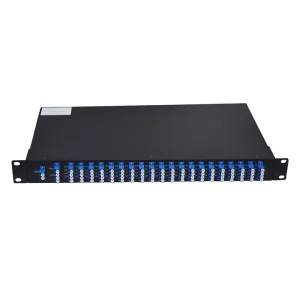
Explore our factory-direct active transceiver modules, passive DWDM Multiplexers, and low-loss structured cabling assemblies engineered for carrier-grade applications.
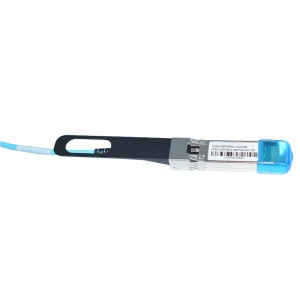
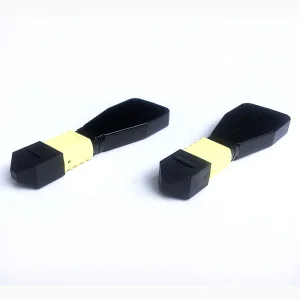
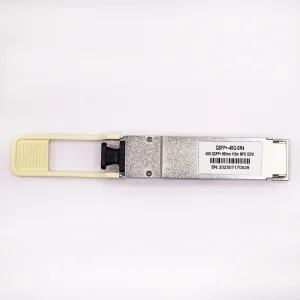
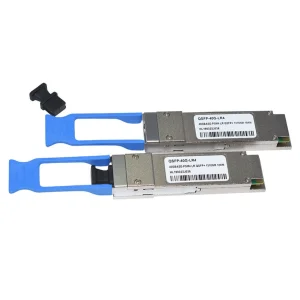
Established in 2012 in Hong Kong as a hi-tech communication enterprise, Kocent Optec Limited has emerged as one of China's leading fiber optic termination product manufacturers and solution providers. We are systematically dedicated to developing and manufacturing advanced fiber optic communication products. Our portfolio spans across passive cabling systems and active optoelectronic devices optimized for carrier telecommunication networks, enterprise structures, and modern cloud data centers.
By leveraging our extensive engineering expertise and robust production infrastructure developed over more than a decade, we magnify operational efficiency for global clients. We collaborate closely with networking engineers to build robust, scalable architectures that enable our partners to outperform their industry competitors.

As AI workloads, machine learning clusters, and high-performance computing (HPC) strain existing data center fabrics, the transition from legacy 100G interfaces to 400G and 800G is accelerating. Understanding the optical fiber medium and hardware interface migration is crucial for design engineering teams targeting future compatibility.
Traditional 100G connections rely on 4 channels of 25Gbps NRZ modulated lanes. For short ranges, MTP/MPO multi-mode configurations (SR4) run over OM3/OM4 fibers, while long-haul interconnects use Duplex LC Single-Mode fibers running WDM technology (such as CWDM4 or LR4).
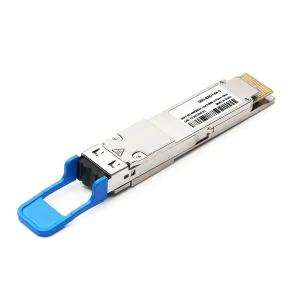
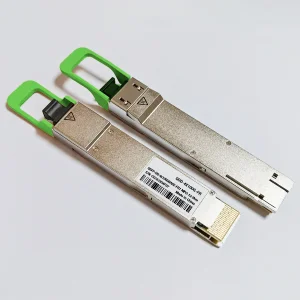
Upgrading to 400G requires transitioning from NRZ to 4-level Pulse Amplitude Modulation (PAM4) at 53-56 Gbaud, reducing the fiber lane requirements. Using components like the KCO-QDD-400G-LR4-S, data centers run 4 parallel PAM4 waves over 10km distances, bypassing localized layout bottlenecks.
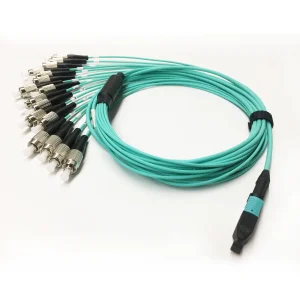
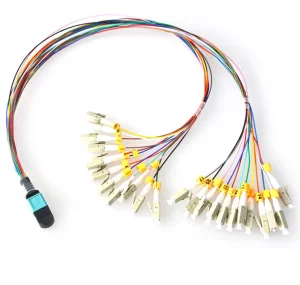
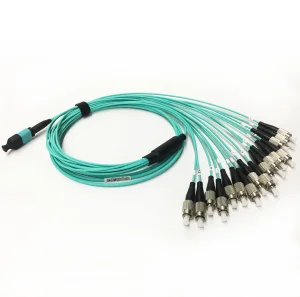
Next-tier architectures utilize 112Gbps per lane serializer/deserializer (SerDes) structures. MTP/MPO-16 and breakout technologies (like MPO-16 to FC or LC fanouts) allow operators to split super-channels into structured trunks, ensuring compatibility with upcoming switches and Silicon Photonics engines.
| Interface Standard | Modulation Scheme | Fiber Type / Connectors | Max Transmission Distance | Primary Industrial Use-Case |
|---|---|---|---|---|
| 100GBASE-SR4 | NRZ (4x 25G) | OM4 MMF / MTP-12 (PC) | 100 meters | Intra-rack, switch-to-switch interconnects |
| 100GBASE-LR4 | NRZ (4x 25G WDM) | G.652 SMF / LC Duplex | 10 kilometers | Metropolitan area links and inter-building spans |
| 400GBASE-SR8 | PAM4 (8x 50G) | OM4 MMF / MTP-16 (APC) | 100 meters | High-density AI cluster fabrics, machine learning networks |
| 400GBASE-LR4 | PAM4 (4x 100G) | G.652 SMF / LC Duplex | 10 kilometers | Hyper-scale data center backbones (DCI) |

Different networking topologies present distinct environments that require tailored components to prevent optical losses. Kocent Optec designs custom end-to-end setups to solve modern deployment challenges:
Operating out of our manufacturing centers in mainland China, we maintain complete control over the fabrication process, from glass processing and ferrule centering to terminal polishing and compliance testing.
To ensure high quality, we rely on advanced metrology equipment including 3D interferometers, optical return loss (ORL) testing rigs, and automated environmental chambers. Every single patch cord, connector assembly, and transceiving module undergoes rigid testing before boxing.

Kocent Optec products are manufactured to meet global regulatory and performance standards. This ensures compatibility with existing hardware installations from legacy manufacturers like Cisco, Juniper, and Huawei.
Our OEM and ODM offerings are qualified to win tenders for major telecom operator infrastructures. We serve leading network operators globally, including:
SingTel, Vodafone, America Movil, Telefonica, Bharti Airtel, Orange, Telenor, VimpelCom, TeliaSonera, Saudi Telecom, MTN, Viettel, Bitel, VNPT, Laos Telecom, MYTEL, Telkom, Telekom, Entel, FiberTel, StarFiber, Ooredoo, Beeline, Azercell.
Technical answers to help network architects, procurement managers, and systems integrators make informed sourcing decisions.
MPO (Multi-Fiber Push On) is the generic industry standard connector type defined by IEC-61754-7. MTP is a registered trademark of US Conec and refers to a high-performance version of the MPO connector. MTP connectors feature mechanical improvements, including a floating ferrule to maintain physical contact under load, guide pins that reduce wear, and removable housings that allow for easy polarity adjustments in the field.
Our active optical modules, DACs, and AOCs are programmed with vendor-specific EEPROM code inside our test lab. By simulating the target host systems (e.g., Cisco, Juniper, Arista, Huawei), we ensure that the transceivers are recognized by host switches, preventing software errors during installation.
With multi-fiber connectors, minor variations in pin height or ferrule geometry can result in air gaps at the physical contact points, increasing insertion loss and back-reflection. Our 3D interferometer tests verify parameters like fiber cut-back, height, and radius of curvature to ensure reliable transmission across all fibers.
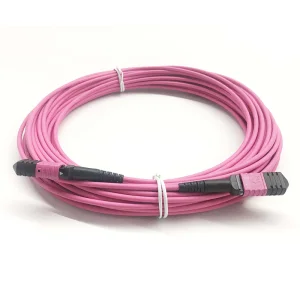
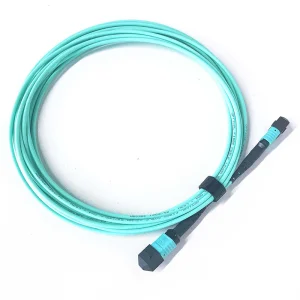
We supply MTP/MPO cable trunks and patch cords in Type A (straight-through), Type B (crossover/rolled), and Type C (flipped-pair) polarity profiles. This enables compatibility with both parallel optics transmissions and traditional duplex breakout routing paths.
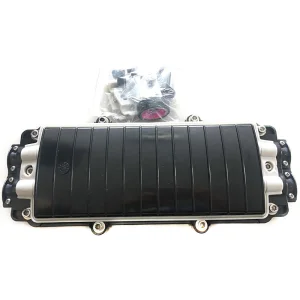
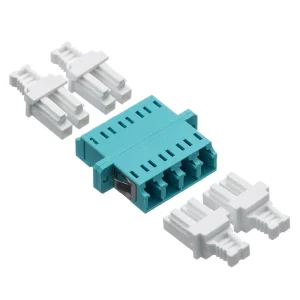
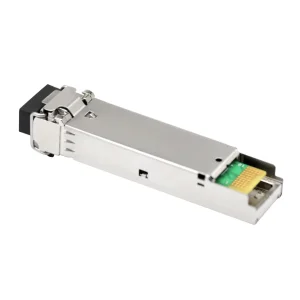
Discover our highly durable fiber splice boxes, multi-port optical adapters, breakout harnesses, and active transceivers designed for high-density architectures.

 KOCENT OPTEC