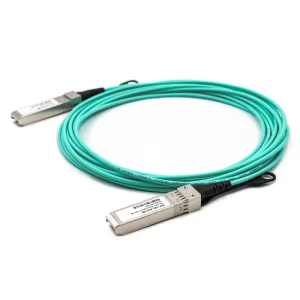
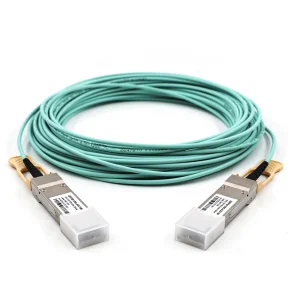
Direct Attach Copper (DAC) cables have emerged as the industry standard for short-range high-speed interconnects. Operating over passive twinaxial copper assemblies, SFP+ DACs link physical switches, servers, and storage nodes within rack enclosures. Unlike optical transceivers which require internal laser diodes and photodetectors to convert signals from electrical to optical domains, DAC cables utilize low-loss twinaxial cables directly terminated to high-frequency printed circuit boards inside the transceiver housing.
This simple physical setup yields two key operational advantages: ultra-low latency (close to zero as there is no O-E-O conversion delay) and minimal power consumption (under 0.1W for passive DACs). In modern high-frequency trading networks, cloud compute clusters, and localized edge architectures, choosing SFP+ DAC configurations dramatically improves network efficiency while lowering your Total Cost of Ownership (TCO).

Years Manufacturing Experience
Switch Compatibility Tested
Insertion Conversion Latency
Tier-1 Telco Partnerships
Engineering robust high-speed physical layers requires choosing between passive and active direct attach architectures. While both use high-speed copper twinax to transmit differential signals, they differ in signal treatment and max reach:
No active components inside the module. Signals rely entirely on the host system's PHY pre-emphasis and equalization to maintain data integrity. Ideal for short runs (0.5m to 5m) within the same rack.
Features active linear equalizers or limiting amplifiers inside the SFP+ shell. This boosts the high-frequency signal, compensating for copper attenuation. Extends transmission reach up to 10m-15m over thinner AWG wires.
Built with double-shielded high-speed twinax. Pair shielding plus overall braid shielding keeps NEXT (Near-End Crosstalk) and FEXT (Far-End Crosstalk) values well below MSA-specified limits.
Copper wire thickness (measured in American Wire Gauge, or AWG) directly impacts how far a high-frequency signal can travel before attenuating. Our production lines use customized wire profiles to balance bend-radius requirements with insertion loss budgets:
| Cable Length (m) | Recommended AWG | Outer Diameter (OD) | Min. Bend Radius | Max. Power Consumption |
|---|---|---|---|---|
| 0.5m - 1.5m | 30 AWG | 4.2 mm | 25 mm | Passive (0.1W Max) |
| 2m - 3m | 30 AWG / 28 AWG | 4.5 mm | 28 mm | Passive (0.1W Max) |
| 5m | 26 AWG / 24 AWG | 5.2 mm / 6.0 mm | 35 mm | Passive (Host dependent) |
| 7m - 10m | 28 AWG / 26 AWG | 4.8 mm / 5.2 mm | 35 mm | Active (0.5W to 0.8W) |

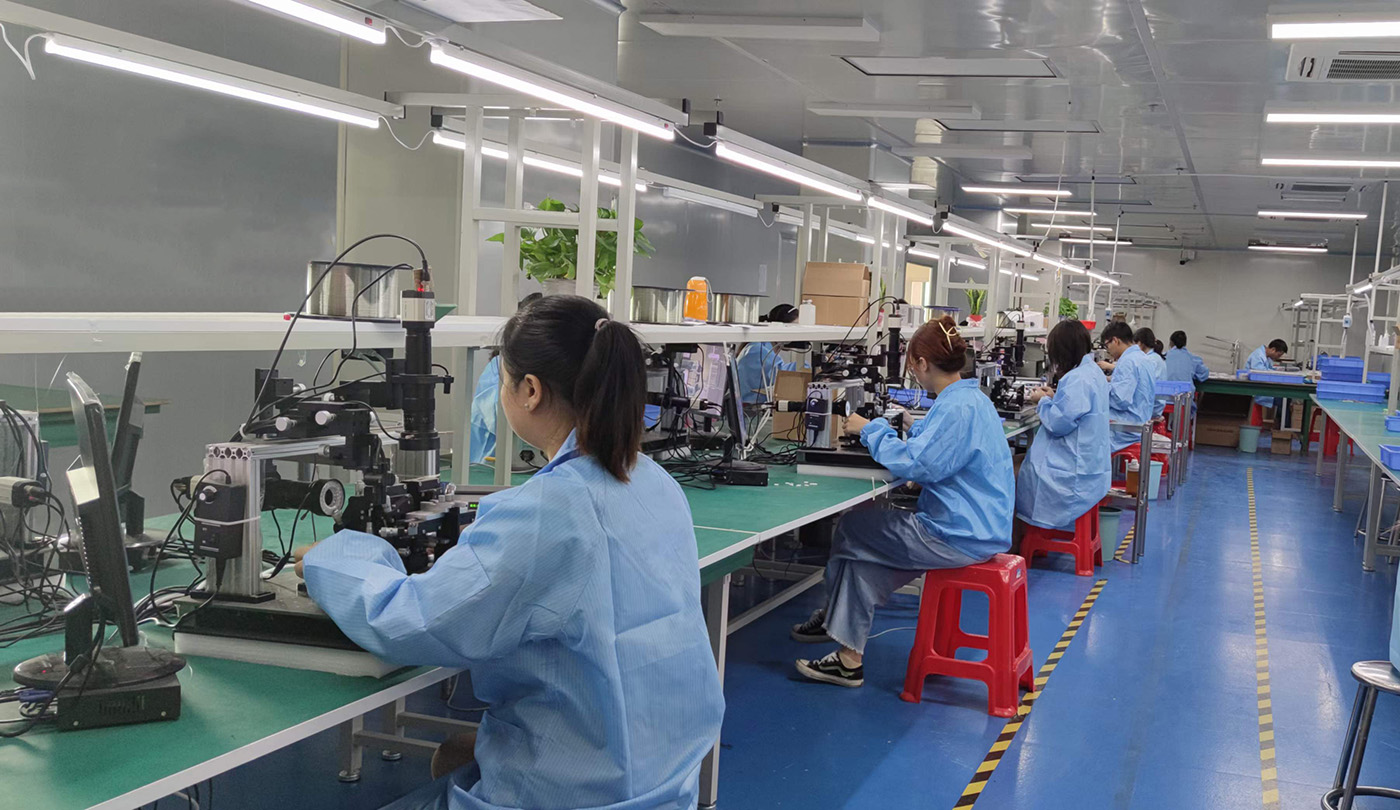
Established in 2012 in Hong Kong as a high-tech communication enterprise, Kocent Optec Limited has grown into a leading manufacturer and solution provider of fiber optic termination products and high-speed copper interconnects in mainland China. Leveraging over 13 years of technical experience and extensive production capacity, we support global procurement managers, telecom operators, and system integrators.
Our vertical integration in China's advanced manufacturing hubs ensures total control over the entire assembly process. From raw twinax wire extrusion and automated wire-stripping to ultra-precise laser soldering and dual-shielding crimping, every step is strictly monitored. By keeping production in-house, we secure stable raw materials, lower assembly costs, and maintain highly competitive bulk wholesale pricing.
At Kocent Optec, we strictly follow international fiber and copper industry standards (including Telcordia GR-326, SFF-8431, SFF-8472, IEEE 802.3ae, and RoHS). By using mature, scientific test methods, we ensure zero field failures and provide 100% physical and electrical inspection reports before shipment.
Our commitment to win-win cooperation has helped us earn contract wins and tenders with leading telecom operators worldwide. Our products are actively deployed in networks operated by:
Whether upgrading regional carrier central offices or building edge computing hubs, our OEM and ODM assemblies meet the strict reliability demands of modern telecom infrastructure.
As networks face rising throughput demands from AI workloads and massive data pipelines, Direct Attach Copper technology continues to evolve. While 10G SFP+ remains a reliable, cost-effective standard for enterprise LANs and basic storage networks, the physical media roadmap has expanded to support next-generation architectures:
Utilizes the same physical interface footprint, but upgrades internal trace designs to handle 25 Gbps NRZ signals. Perfect for migrating enterprise server connections to high-speed lanes.
Aggregates 4 lanes of 25 Gbps (or 2 lanes of 50G PAM4) to achieve 100G bandwidth, serving as the standard Leaf-Spine backbone interconnect in modern architectures.
Featuring built-in DSPs for retiming and signal conditioning, AECs bridge the distance gap, allowing copper to run up to 7-10 meters at 400G and 800G speeds without heavy bulk copper.
By using modular manufacturing tooling, Kocent Optec's factories can scale production lines quickly. We can easily pivot to supply custom configurations like SFP28, QSFP28, QSFP-DD, and QSFP56 hybrid breakout configurations, helping protect your hardware investments as your network grows.
 KOCENT OPTEC