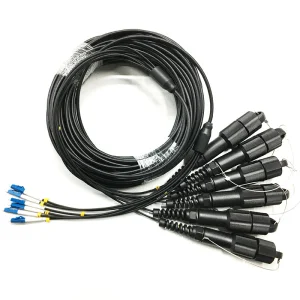
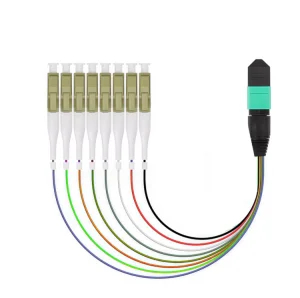
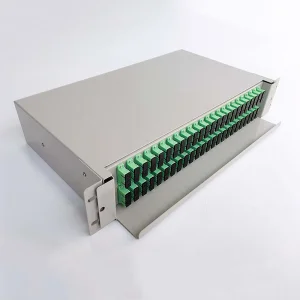
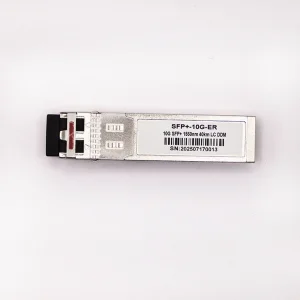
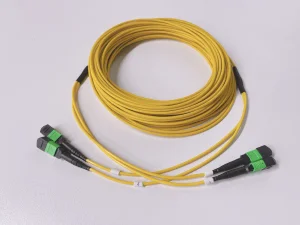
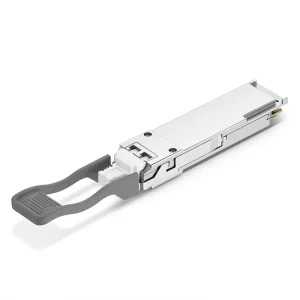
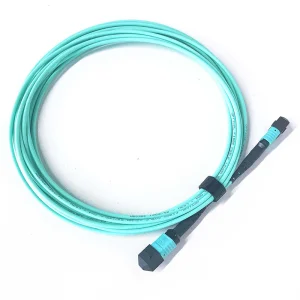
The transition from legacy 10G serial architectures to high-speed 40G Ethernet (40GBASE-SR4 / 40GBASE-PLR4) requires parallel optics instead of duplex configurations. Multi-Fiber Push-On (MPO) connectors, engineered under strict IEC 61754-7 and TIA-604-5 standards, allow the transmission of optical data across multiple fibers simultaneously. By housing up to 12, 24, or even 72 fibers within a single compact ferrule, MPO links maximize rack utilization and significantly reduce structural cable bulk.
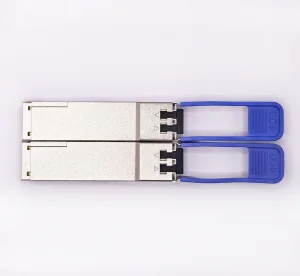
To transmit 40G speed over OM3 or OM4 multimode fiber, QSFP+ modules utilize 4 parallel transmitter lanes and 4 parallel receiver lanes, each operating at 10 Gbps. A standard 12-fiber MPO connector accommodates this configuration by designating the outer 4 channels for Tx, the opposite outer 4 channels for Rx, leaving the center 4 fibers unused. Understanding these alignment structures is crucial for minimizing back-reflections and insertion loss.
Below is the comparison of mechanical and performance metrics required for high-density, mission-critical infrastructure deployments.

Established in 2012 in Hong Kong as a hi-tech communication enterprise, Kocent Optec Limited has grown into one of China's most trusted manufacturers of fiber optic termination products. We are dedicated to developing, manufacturing, and supplying fiber optic communication components, ranging from passive components to active optoelectronic modules for modern telecommunication networks, enterprise infrastructures, and next-generation data centers.
By leveraging our extensive engineering experience and state-of-the-art production capabilities, we maximize network output for our valued customers. We prioritize active collaboration, operating not just as an OEM supplier, but as a strategic development partner in structural cabling and fiber distribution.
Method A utilizes a straight-through mapping scheme, routing Pin 1 on one end directly to Pin 1 on the far end. Key-up to key-down MPO adapters are used to maintain fiber sequencing. While simple to deploy, Method A requires utilizing cross patch cords (A-to-B) on one end of the link to execute the TX-to-RX flip, maintaining proper end-to-end signal routing.
Method B maps Pin 1 on one end to Pin 12 on the opposing end, creating a complete crossover structure. It utilizes key-up to key-up couplers. This design automatically applies the TX-to-RX crossover polarity directly within the trunk cabling. Standard straight patch cables can then be utilized at both ends, making it ideal for parallel 40G/100G architectures.
Method C performs a pairwise flip, where adjacent fiber pairs (1-2, 3-4, etc.) are crossed. It uses key-up to key-down MPO adapters. While highly optimized for classic duplex channel transmission (e.g., routing patch panels to 10G SFP+ switches), Method C is generally not recommended or adapted for parallel 40G/100G QSFP+ transceivers.
Sourcing high-quality 40G MPO components requires balancing tight capital expenditures with strict performance metrics. Sourcing from our modern manufacturing base in Shenzhen, China allows operators to optimize cost efficiency without sacrificing quality. China's integrated supply chain ecosystem provides key advantages:

High-density MPO and MTP fiber systems are deployed globally to support bandwidth-intensive applications. Below are the primary technical applications where 40G MPO structures provide crucial routing density:
Modern hyper-scale data centers rely heavily on a spine-leaf network topology. High-density 40G MPO trunk cables form the physical backbone of this design, interconnecting high-density leaf switches with central spine switches. Deploying multi-fiber pre-terminated MPO trunks allows operators to scale network capacity and reduce deployment time from weeks to days.
Next-generation 5G C-RAN (Centralized Radio Access Network) hubs concentrate Baseband Units (BBU) away from antenna towers. MPO trunks bundle multiple optical links from BBU pools to remote radio heads (RRH) at tower tops via PDLC outdoor hardened patches. This structure resists environmental ingress while ensuring low insertion loss and high phase coherence across all carrier wavelengths.
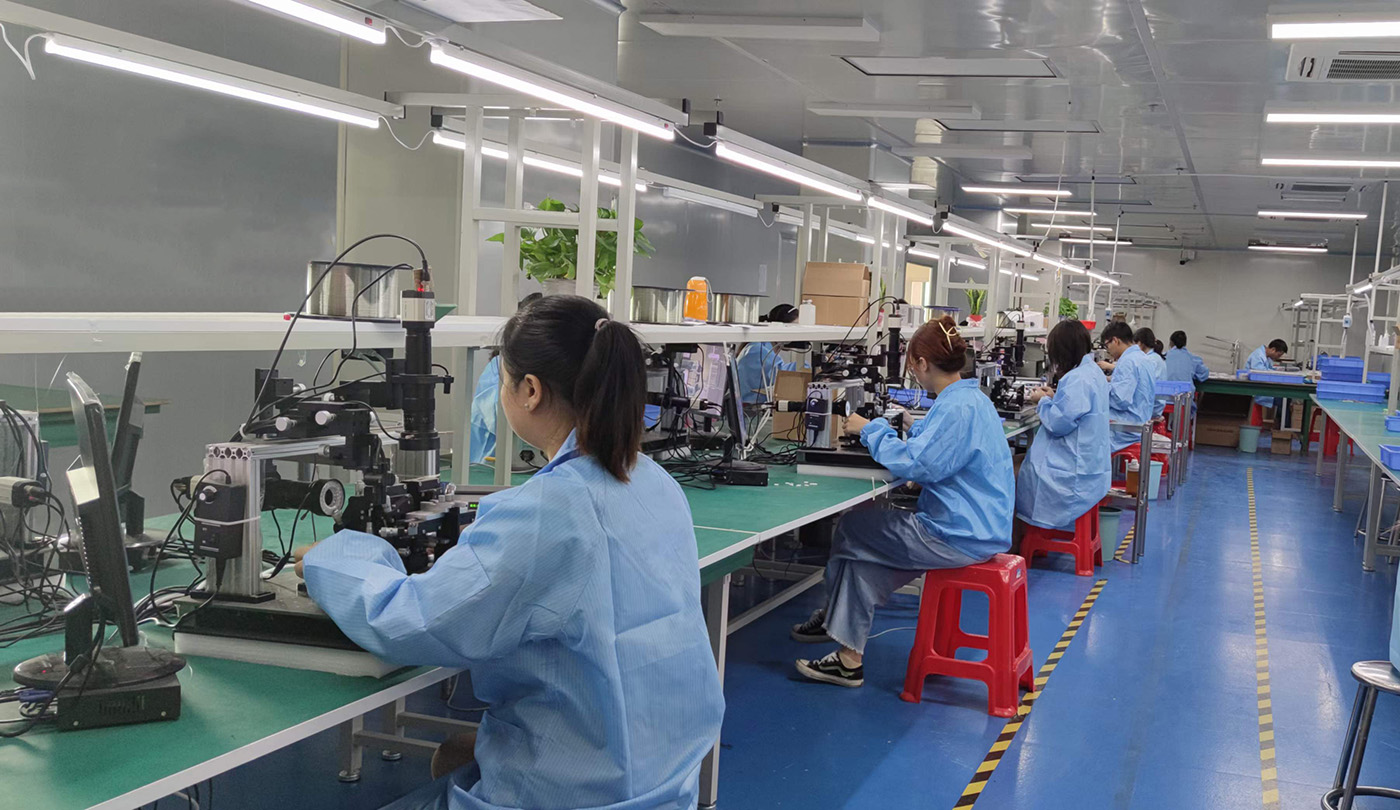
With over 13 years of experience in manufacturing telecommunication fiber optic products, Kocent Optec Limited adheres strictly to international quality standards. We implement mature scientific testing methods to deliver your products on time and ensure that 100% of our products are tested and inspected before shipment.
Our commitment to quality has earned us partnerships with tier-1 telecom operators and system integrators worldwide, including:
SingTel, Vodafone, America Movil, Telefonica, Bharti Airtel, Orange, Telenor, Saudi Telecom, MTN, Viettel, Bitel, VNPT, Laos Telecom, MYTEL, Telkom, Entel, Ooredoo, Beeline.
As bandwidth requirements expand, network architectures must adapt. The design of MPO cabling systems provides a clean upgrade path from 40G parallel optics to higher-speed standards. Here is how standard MPO configurations transition:
Uses 4 active Tx and 4 active Rx lanes over a 12-fiber MPO connector. It utilizes standard multi-mode OM3/OM4 fibers, with data rates reaching 10 Gbps per channel.
Transitions from 10G to 25G channels. 100GBASE-SR4 utilizes the same 12-fiber MPO connection scheme but runs at 25 Gbps per channel. 24-fiber links can support 10 Tx and 10 Rx configurations.
Utilizes 16-fiber MPO or MTP connectors. Incorporating PAM4 modulation yields 50 Gbps or 100 Gbps per fiber channel, enabling maximum density across backbone networks.
 KOCENT OPTEC